It's not likely, but if you're worried check it with a straight edge. The block I'm checking here had a severe overheating episode (driven until it was dead) and was still within limits. Tim
Well i am currently on about a 300 mile round trip test. I drove it around town and everything seemed good. On the highway going 65 it got warm again, then over the pass it got warm, never more than 3/4 though and i would run the heater just for precaution and it would drop down to about normal. No signs of oil in coolant or coolant in oil, no signs of burning or leaking them either so far. Need to check and see if i can see any bubbles coming through the coolant when its running but i doubt it. All those things would mean i installed the gasket badly or wrong, but im pretty confident it was an acceptable job that will last. The only thing i could think of as to why this is happening is the timing. I meant to adjust it when i did everything but forgot. I went ahead and advanced the timing last night at our campsite, so ill see if that helps. Ill do the timing properly with a timing light as soon as i can at home, thats one tool i dont carry in the car haha. Have my fingers crossed on this one as i really love this van and have too much into it at this point, id be taking a huge loss. I also had to sell my 2wd van to get this, so it better freaking work!
Thanks, i knew the timing was retarded pretty far, so i only adjusted it a bit to see how it would affect the temp until i could get home and do it correctly. At first i thought it made a big difference, but then the same old thing. Closer to home i realized my electric fans were not working (i had the heaters going most of the time and it kept it within range, at least comfortably away from the red). Anyway, i got home, fixed my fans (blown fuse and i bypassed the switches i put in so now they run all the time) and set the timing per FSM, got it to 12 with check engine wire installed and it was at 20 when removed. I took it on another run and guess what?! Same issue! Still getting warm under load. I feel like i could cruise around all day on flat ground going town pace, but highway speeds or going up long hills is getting this van.
Im really at a lose here, i have replaced the thermostat, fan, flushed cooling system, replaced head, headgasket, everything in between, did the timing and even removed my ac stuff to help with air flow. I dont think the head gasket, head or block are compromised as i dont see any signs. The guy i bought it from a couple months ago replaced the radiator with one from an automatic with the extra little hose connectors, i have the original as well but its leaky. Im pretty sure he said he replaced the radiator cap and water pump as well, radiator cap looks new at least. Anyone got any more ideas?
Thanks for anymore insight.
Last edited by Jlhollowx13; 06-14-2015 at 04:42 PM.
Ok, i went out to do some more testing. The first time around, when i first finished the job and filled the coolant i didnt see any bubbles or anything coming from the radiator cap. This time i let it run for 20 minutes, all stayed cool. I ran the heaters to try to further burp the system and didnt see any bubbles in the coolant. Then i shut the heaters off and let it run and i began to see some slight bubbles coming up. How can this be? Do i have a warped block? My wife is ready to put this thing up for sale, i love it and have put alot of money and my time into it. I just dont see how i can still be getting exhaust in the coolant, thats why i did all this to begin with.
Im assuming my block is warped at this point. Dont know what else it could be. Any ideas? Do these require you to retorque the head bolts? I dont remember seeing that in the FSM. would that help?
I doubt the block is warped. Does it have an OEM t-stat or aftermarket? Fan clutch OEM or aftermarket?
I hope its not but at this point i dont know what it could be. I have a brand new oem thermostat from 1st toyota, my fan is a dual electric from Flex-a-lite. But im definitely seeing some small bubbles in the radiator cap when she warms up. I just dont see how my head gasket can be compromised again. It got warm on this last trip but not to the red like before, so i dont see how i could have blown the head gasket without it overheating. I can let it sit all day and it seems to stay perfectly in range when idleing, just under a load it gets warmer than it should.
I really want to get this figured out, im going to be very deep in the hole if i cant. Thanks for any insight tim, i could use all the help i can get at this point.
On interesting thing ill note is that when i put the new head gasket on it was blocking a couple passages, when i took the old one off these passages were blocked and i thought maybe someone had used head gasket sealer and it caused them to plug up. The head gasket also came from 1st toyota and has toyota oem packaging, so im sure its oem and im sure the other one was original (only 130k miles) but both seemed to cover a few holes between the lifters and pistons. I accidently ordered 2 HGs and the other one was also identical.
Not sure if that means anything but just trying to put it all on the table. Id love to have a working van with this low of miles!
Last edited by Jlhollowx13; 06-15-2015 at 09:16 AM.
Well i went back out tonight when i got off work and let her warm up again. Upon initial startup and up to about 1/4 on the temp gauge no signs of bubbles. Then after 1/4 i start to see single bubbles every so often and it gets progressively worse until its kind of frothy small bubbles. Somehow the head gasket is not holding!seems to be worse than it was yesterday.
Anyway, i talked to a family friend that owns a shop down the street and hes going to test it for me with one of those kits tomorrow, im pretty sure its gone again, but wont hurt to make sure and get to play with a tool i dont have. Assuming it is bad, ill tear it down tomorrow before work and see if i can see anything obvious. The guy at the machine shop was kind enough to offer to come to my house on wednesday night as he was going to be in the neighborhood and check the block with his precision straight edge (assuming i can tear it down before he arrives). From there ill have a better idea of what to do next. As much as ill be angry with myself, i really hope it was my error installing it and not the block, but either way something isnt right in there. Might have him check the head while he is here as well, wouldnt hurt.
Any tips or input or words of encouragement are much appreciated!
Hi & sorry for not replying earlier. I saw your post this morning, but was too busy with work to reply. Of course it was a long day, and I'm about ready to nod off, but this seems urgent so I'll offer what I can.
Panic and extreme frustration/agitation is a perfectly normal response to an issue like this (especially after doing such a big PITA job). I've been there more times than I'd care to admit, and I can tell you it almost never ends up being as bad as you think. Even if it is, the good news is YOU ARE THE MASTER OF YOUR VAN! After a job like this, you remember every detail. Nobody knows your van better. Remember why this was such a PITA job the 1st time around? It was due to all the grime, hoses that broke, connectors that broke, bolts that stripped, etc. If you took care of these things (did the job right) everything should now be fresh, new, & easy to remove. Yes it's annoying to tear things down again so soon, but I bet you could fly through it the 2nd time around (and do a better job). I don't know about you, but I'm sure there are things you thought about afterward and wished you'd done differently........well, guess what?.....you just might get the chance
.
That being said, as hard as it is, I would try to avoid jumping to any conclusions until you have more facts. Did you ever see other signs of overheating (like coolant puking out from recovery bottle)? Definitely do the block test to see if there's any combustion gasses in the coolant. I'm guessing there isn't, but if there is, well, that just sucks........but at least you'll know the head needs to come back off (and as discussed above, you got an ace up your sleeve in that department). If there's no combustion gasses detected (and I suspect there won't be), then I wouldn't pull the head. Something I'd like to point out is accuracy of these stock gauges. Having actual numbers is a big plus when trying to determine how big of an issue it is. My cargo van will start going into the red at 220 deg F, but my 86 LE will only be half way up the scale at 220 deg F. If you're running it with the fill cap off the engine for testing, and if it overheats during these conditions, you can always stick a meat thermometer down there. If it only overheats while driving, then having an aftermarket temp gauge with numbers is a great tool. Even for normal driving in a van without issues it's nice to see & know coolant temperature. A temperature gauge you don't need is not something you'll ever regret installing. Gauges are not that expensive, just be sure it has an electric sender (capillary tube types can't be extended and are typically too short for the van).
Personally I wouldn't be too worried about a few bubbles in the coolant. There is turbulence down there and bubbles will form. You will see them especially when the thermostat opens initially. When combustion gasses get into the coolant, depending on the size of the breach, it can get a lot more interesting than seeing a few small bubbles. Just remember the cooling system normally only sees around 13 psi. The combustion pressures are typically around 150 PSI or more. If you get a breach, it's not unusual to see a gallon or more coolant puking out of the recovery tank in under a minute. The other thing to remember is these type breaches are usually a 2 way street. When engine is running, coolant sprays out, but when engine is shut-off, coolant will usually leak into the cylinder(s). When you try to start again, sometimes there will be enough in there to hydro-lock the engine. For a small breach, usually you will see steam coming out the exhaust & it will smell like coolant (nothing else quite smells the same as atomized/burning ethylene glycol).
If you do pull the head again, check everything this time. Stick a coat hanger or something down each coolant hole in the block and probe/feel for sediments (especially near the back of the engine). Check deck and head with a straight edge & look for cracks in the head (pay particular attention to the space between intake and exhaust valve seats). If your machinist actually comes over, then that's service! (and he's a great guy). Pick his brain while he's there. I'm guessing he's seen some weird stuff before. Putting your heads together might put you on the right track. Good luck. Tim
Tim, thanks for you input and positive reinforcement. I definitely feel like i know this van well now, and i like that. In the short amount of time i have owned it i have become quite familiar with it, on par to my land cruisers ive had for years and done much to. I know i could do another head gasket on this in about half the time, and im getting VERY quicK at removing the passenger seat and engine access hole haha.
Anyway, on to what ive come to find today. So far the news is looking up. I went in to my friends shop and he did the exhaust in coolant test with negative results!he also said he didnt think it was a head gasket issue and he saw the bubbles in person. He also sisnt think it was an HG based on what i explained was happening. That gave me confidence. He let me borrow his compression test kit to further expand my knowledge of the situation and also said he thought my radiator might be clogged based on the symptoms i was experiencing. When i got home i did 3 tests on each cylinder and im getting 125 to 130 psi consistently on each cylinder (this was done with all spark plug wires disconnected) i havent looked up whether or not that is within spec, but being all consistent gives me hope. I also pulled my radiator, rinsed it out as thoroughly as i could, put radiator flush liquid in it, let it sit as directed and rinsed thoroughly again. I was in the process of putting it back together when i had to leave for work so ill finish it up amd road test it. I also plan to get a new rad cap to rule that out. If it helps i plan to get the radiator recored when i can get my funds back up, but i hope it will solve it for the time being. If not i will continue trouble shooting.
I am wondering 2 things. 1 should i get a toyota oem radiator cap like the thermostat or is any ok? 2 i have the original radiator and i also have a radiator from an automatic (installed now). The original has an obvious leak, but if i take one in to a radiator shop is one or the other better? (po said automatic was bigger but they look the same to me minus the extra nipples on the auto).
Thanks again, im feeling much better about things now, at least it doesnt seem as though the head gasket is bad!
Ok, so i just checked the FSM for proper procedure and specs for compression. I obviously didnt do it per the manual, but rhe minimum compression is 125, so im within range, but considerably lower than the 178 psi it says is right. Could it be from not following the right procedure, or is it even anything to worry about?
Quick update:
Went home for dinner break and checked compression per FSM. Getting 140 psi across the board on 3 tries each cylinder, yay! One cylinder had some wet stuff on it, but probably from my doing it wrong the first time. I filled the coolant and finished putting the radiator in as well, but i was getting some steam coming off thw radiator. When i was done i pulled the fans back and the radiator is moist. Either i sprung a leak cleaning it out, or its residual water feom when i was cleaning it, but i had to leave so i couldnt let it run to see if i see any seapage, ill do that tonight when i get home.i figured any water on it would have dried out here in the 4 hours it sat, but maybe not.
Sounds like you're getting it dialed in. I never worry too much about actual compression numbers, it's the consistency. I usually pull all the plugs, then it's easy to count the compression pulses. I always go 5 pulses per cylinder & typically see around 160 psi or so each.
Other than the built-in transmission cooler the radiators are the same, but I suspect the original one has better (thicker) tanks. If I had to run an automatic radiator I wouldn't hesitate to do so, but if I had a choice, I like things to be original and specific to the vehicle I'm working on. If I were in your position, to rule out the radiator, I would have the original radiator recored with a high efficiency 4 row unit.
I'm indifferent on the brand of radiator cap you use. Just make sure the seal area of your fill port is smooth around the periphery (no pits) and the rubber part of the cap fits correctly over it. Tim
Thanks tim. I'll be road testing it to see if my clean job did anything. If so I'll use it as is until I get a chance to run to the closest radiator repair shop (120 miles round trip). I've actually got a few spare radiators I could take in so I may do that if this one works for a bit. If it doesn't I'll be making the trip sooner!
one tip I'll put out there that I learned doing this job is check the injector o-rings. I put mine back together and had a fuel leak from the 4th injector, after tearing it back apart i found a bad oring. Lesson learned.
Tim, or anyone that can help, how can i donate to the site? I know you guys do alot to keep this going and for someone like me that likes to do thier own stuff this site is very valuable. I want to give back someway (when i get paid at the end of the month since this project has wiped me out for the moment). I know it wont help much compared to what it takes to do what you guys do, but its something i can do to help. Again, i cant convey my appreciation to you all enough. THANK YOU!!!
Thanks for asking. The easiest way is via PayPal. If you don't already have an account, it's easy to set one up. If that doesn't work for you, we could also accept checks or money orders. If you go that route please PM myself or Gwen (llamavan) for our mailing address. We have a "Make a Donation" link to PayPal at the bottom right of every page. Once there just fill in the amount and answer their questions when prompted. Don't worry about the size, it all adds up. We let it accumulate and when it's time to renew our hosting and/or domain name we pull from there to do it. Up until the last time we renewed we had to pay most from our own pockets. The last time we renewed there was actually enough there!!! (but just barely). We are happy to donate our time, but it stings a bit when we need to pay out of pocket to do so. So keep the $$$ coming. We don't need much, just a little here and there is a tremendous help. Thank you everybody for helping us pay for the site! Tim

Thanks tim, i see the make a donation button now that im looking. I'll be sending something over to help as soon as I get paid!
Im still running into some issues. I pulled the radiator and let some radiator flush sit in it, not really much crud came out but I flushed it really well. My buddy told me to try white vinegar, so that has been sitting overnight. I'm currently flushing the block with a hose going both directions for 1 hour each, I'll do the same for the radiator when the block is done and I have a hose free and will also put some baking soda/water mix through to neutralize the vinegar. After all this I have some other stuff, rmi25 or something, a radiator cleaner that I'll put in as well for another boost. The flow through the radiator seems adequate and since I'm not really getting any crud through the radiator I feel like it's probably clean, either that or so dirty that everything is sticking together. I called the shop in the next town and got quotes for rodding the radiator out as well as general estimates on recores, but all my options are a bit over budget at the moment (the new exhaust manifold and head really got me on this one).so, I'm going to do what I can myself to try to remedy the problem. My original radiator has a leak in one of the cores, I may try to fix it myself, clean it out and swap it in if this one doesn't work, also open to any other suggestions, things to check or try or possible other causes of this issue. Wish it was easier to see into this thing.
I called all around the country yesterday in hopes of finding a brand new radiator to no avail. I called a few radiator repair shops as well to get quotes thinking maybe it would be better to ship it out. I talked to one shop in Michigan, I asked about a 4 core and the guy says it can't be done before I even finish my sentence, when I tell him it can, he keeps going on and on that its not possible. After a couple back and forths, I say, 'ok thanks for your time, I know it can be done so I think I'm going to go with another shop'. He starts telling me how they are the best around, been around forever, blah blah blah, basically trying to get me to become a customer and I'm sitting there thinking, why would I send it in to a shop that says they can't do what I want done? I politely tell him I'm going to go with someone local and he says, 'we are local and the best!', I say no, I'm calling from colorado and I know a 4 core can be done because it's been done, I even mentioned the place in California that makes them, and he still says no, they don't exist, like I'm a liar! I thought the customer was always right? Haha
anyway, the work continues!
Van Enthusiast
Oh man, cool tent set-up! Were you able to probe the block for sediments while the head was off? The van in the thread I linked to before (with all the sediments) was a major PITA to figure out the cause of those overheating issues. I had thoroughly flushed that system with chemicals twice to no avail. When I started the flush it started out extremely dirty (made me think I was accomplishing something). But this was just the fine silty sediments. The big ones stayed behind and restricted flow.
Of course this was an odd ball (no reason to think yours has this issue), but it would be nice to rule it out. Tim
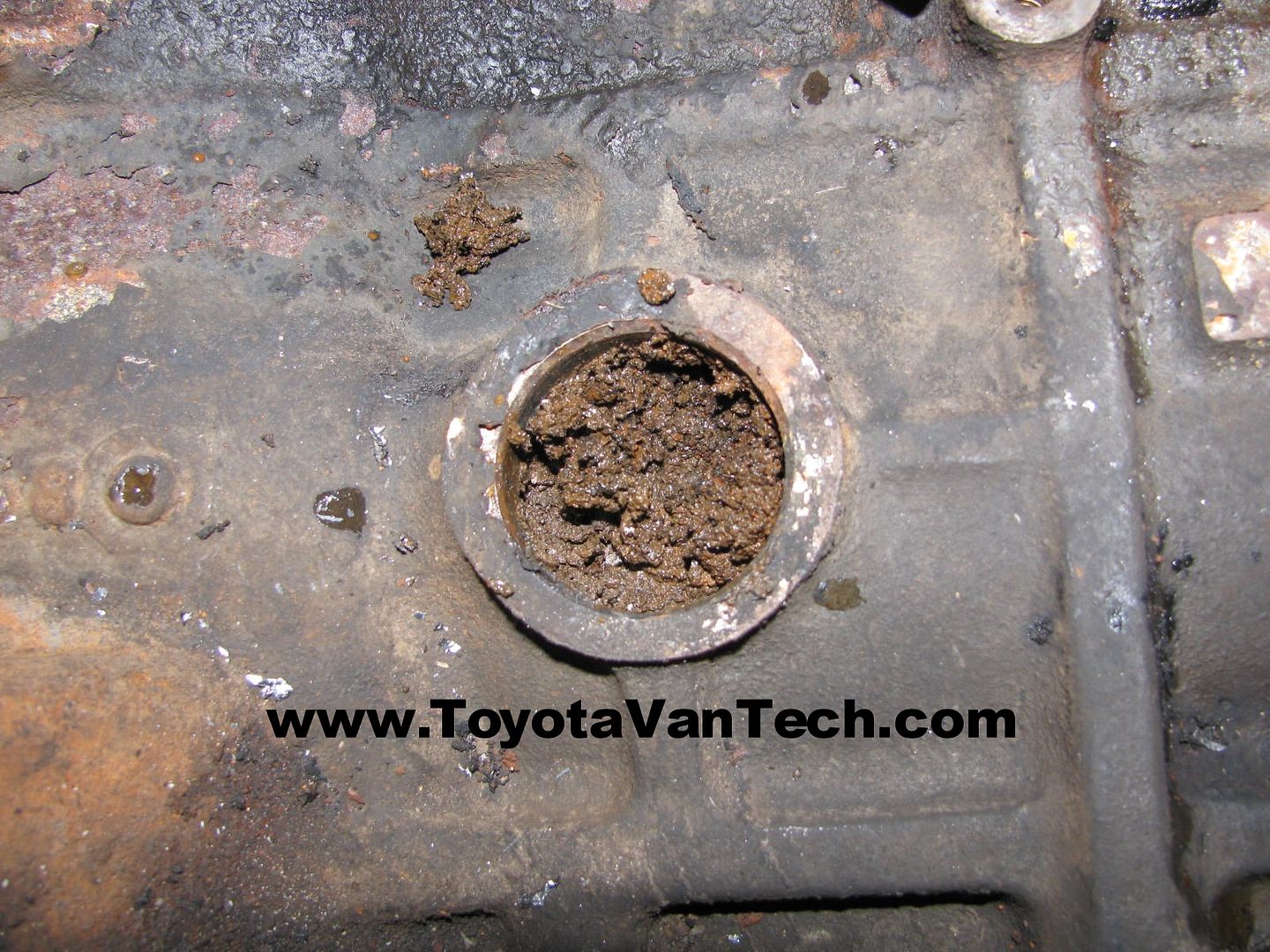
Here's what I found behind the rear freeze plug:
![]()
I cleaned out the coolant passages, they looks really good actually but i took a wet vac to everything exposed and sucked out any coolant, etc that would come out and scraped anything i could see will vaccuming it out. The passages were surprisingly clean, but it had supposedly been flushed out a couple times prior to my purchasing it.
One thing im having trouble wrapping my head around on these vans is the coolant flow and location of the thermostat in relation to other vehicles ive owned. They way i understood how other vehicles cooling systems work is the thermostat atays closed, holding it in the engine unril operating temp is reached, then the thermostat opens, allowing coolant to flow into the radiator, cool, rhen flow back into the engine.
The way im understanding the vans dynamics is it heats up the coolant in the engine AND radiator before the thermostat can open and allow cooling flow. Maybe im mixing the direction of flow up in the van? It seems as though it would flow correctly the other way though considering the hot coolant needs to come through the top and cool coolant out the bottom. Kind of a side note but might give me more insight into the workings.
Does someone know what temp the van should run at? Maybe both under load and at idle/easy driving? Im trying to see how accurate my gauge is with something i know i can count on. Thanks!